

Fresh is healthy
A free roadmap to your healthiest life

Exert: Muscles + Movement
1-minute watch - Click here for sound

Why It Matters
Cardiovascular or aerobic endurance training is characterized by sustained rhythmic activity which elevates the heart rate and increases oxygen consumption. Most common examples include walking, running, swimming, cycling; however, ). Research consistently shows endurance training provides robust reductions in all-cause, cardiovascular, and cancer mortality, alongside improvements in metabolic, cognitive, and functional status. The extent of benefit is strongly related to cardiorespiratory fitness (CRF, measured as VO₂max or METs), with a dose-response relationship - each incremental increase in CRF yields substantial reductions in mortality risk.
[1-3]

Medical Benefits
Endurance exercise increases stroke volume—the amount of blood pumped per heartbeat—and decreases resting and submaximal heart rates, reflecting enhanced heart efficiency. Regular endurance exercise lowers blood pressure, reduces systemic inflammation, improves lipid profiles, and augments endothelial function, directly reducing atherosclerosis risk. Improved metabolic function: Endurance training improves insulin sensitivity, promotes favorable glucose control, and reduces visceral adiposity - key factors in diabetes and metabolic syndrome prevention. Abundant data shows associations between higher cardiorespiratory fitness and lower risk of certain cancers, including breast and colon.
[4-6]

Longevity
Endurance exercise consistently demonstrates reductions in depression and anxiety, improved mood, and cognitive function, and lowered dementia risk, likely via increased cerebral blood flow, neurogenesis, and release of neurotrophic factors. Large longitudinal studies reveal that elite endurance athletes live several years longer than the general population, and even small improvements in CRF among non-athletes confer dramatic reductions in mortality and CVD risk1. Notably, the longevity and health benefits of endurance training far exceed those observed with resistance training only when it comes to CVD and overall mortality, although combining both yields the greatest benefit.
[7-9]

Optimal Strategy
Adults (18-64)
-
Moderate intensity:
50-70% max HR activities
150-min per week minimum
300-min per week optimal
-or-
Vigorous intensity:
70-85% max HR activities
75-min per week minimum
150-min per week optimal -
Combining mix of moderate
and vigorous is superior
(e.g. 150-min mod + 75 vig) -
Best to spread the total minutes across 3-6 days/week
(i.e. 20-60 minutes daily) -
Can be done in bursts as few as 10-min as long as the total minutes per week achieved
-
Resistance training does not count toward cardio total unless done in a circuit to keep HR in category range
Cardiovascular Endurance
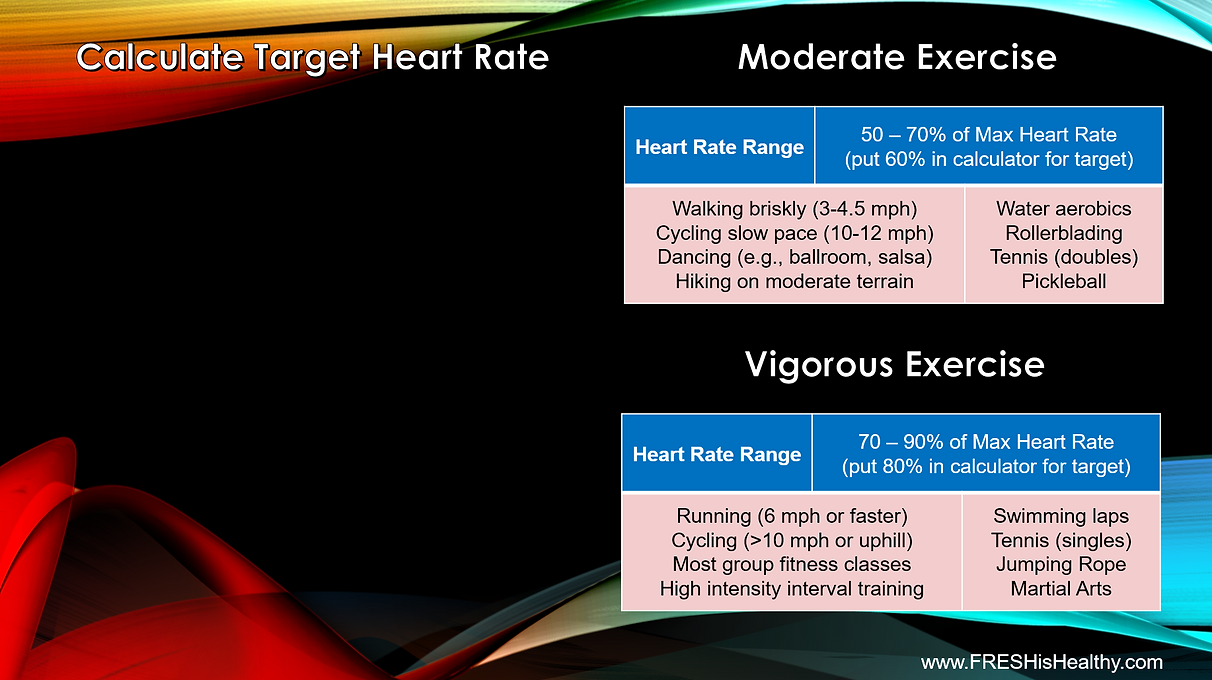
Do not use target heart rate zones if you are taking beta blocker medications.

Why It Matters
Weight resistance work includes body weight exercises, resistance bands, and weight lifting. It was once considered secondary to aerobic exercise, but is now recognized as essential for comprehensive health, independence, and disease risk reduction. Resistance training preserves lean tissue, which declines with age (sarcopenia), thus serves to bolster functional independence, mobility, and frailty prevention. Research shows weight resistance exercises also convey significantly lower risk of osteoporosis and fractures, especially in post-menopausal women and older adults.

Medical Benefits
Resistance training confers diabetes benefits (prevention of and better control of the disease) by increasing insulin sensitivity, improving glucose control, and reduction of overall visceral fat.
It also decreases cardiovascular risk by improving blood pressure (2-5mmHg) and cholesterol (reduces LDL and increases HDL). Resistance training decreases risk of developing certain cancers and leads to better outcomes in patients who have some cancers.
For older adults, weight training reduces fall risk by improving balance, power, and postural control - all critical for maintaining independence in daily living.
[16-18]

Longevity
Multiple recent studies show that resistance training decreases rates of depression and anxiety.
A large meta-analysis study showed that weight training conveys protection against cognitive decline and dementia. When weight resistance is combined with cardiovascular endurance training, it offers both additive and synergistic risk reduction for all-cause mortality (40% reduction vs. 25% for cardio alone or 18% for weights alone). Resistance training is second only to aerobic exercise for mortality reduction but is superior for prevention of sarcopenia, frailty, and osteoporosis in older adults.

Optimal Strategy
Adults (18-64)
-
3 sessions per week targeting all major muscle groups
-
20-30 minutes per session
(60-90-min/week optimal as returns diminish at >120-min) -
1-3 sets and 8-12 reps per muscle group each session
-
Use progressively higher resistance to push muscles from 50% max to total fatigue
-
Rest a muscle group 2-3-min between sets for max gains, but exercise other groups while first group is recovering
Older Adults (≥65)
-
Add balance and functional exercises at least 3 days/week
[20-21]
Weight Resistance
.png)
3-day circuit training program
Download The plan here:
Blank Version of Template
Apple Watch / Fit Bit Version:

Why It Matters
Flexibility training encompasses dynamic stretches, yoga, and functional movement. It improves musculoskeletal pain tolerance, mobility, balance, and well-being. Flexibility and balance training compound the benefits of resistance and aerobic programs, improving ADL performance, reducing injury and fall risk, and enhancing the psychological benefits of movement-based exercise. Combining static stretching and mindful breathing (such as in yoga or relaxation routines) yields superior mental health benefits compared to stretching or breathing alone.

Medical Benefits
Research shows flexibility training maintains joint range and even reverses joint limitations related to age, sedentarism, or chronic conditions. Regular stretching can reduce injury risk (particularly in sports), and reduces muscle soreness by promoting blood flow and nutrient delivery. It is a key tool for managing chronic lower back pain, arthritis, and postural pain. It also improves proprioception and, when paired with balance training, substantially lowers fall risk in older adults; therefore, flexibility is essential for maintaining independence in daily living.
[24-29]

Longevity
Although flexibility training is not independently associated with reduced all-cause mortality, it conveys an indirect longevity benefit as flexibility improves functionality which is critical for sustaining independence and quality of life for people with advanced age and disabilities.
Research shows that consistent functional flexibility programs - namely yoga, dynamic stretching, and tai chi - mediate autonomic and cortical mechanisms which convey significant reductions in anxiety, improvement in focus and emotional regulation, better resilience in the face of stress.

Optimal Strategy
Adults (18-64)
-
2–3 days per week stretch each major muscle group (daily stretches = best results)
-
15–30 second holds for each stretch and repeat each 2–4 times to accumulate ~60 seconds per muscle group
-
Perform when muscles are warm (post-activity/warm up)
-
Static, Proprioceptive neuromuscular facilitation, and dynamic stretching are all effective methods
Older Adults (≥65)
-
30–60 seconds holds for each stretch repeated 2-3 times
[30-33]
Flexibility Training

5-day Single muscle group plan
Download The plan here:
Blank Version of Template
References + Futher Reading
-
Cardiovascular Aging and Exercise: Implications for Heart Failure
https://www.ahajournals.org/doi/pdf/10.1161/CIRCRESAHA.125.325531 -
Why Cardiovascular Endurance Is Important: Don't Skip Cardio
https://fitnessprogramer.com/why-cardiovascular-endurance-is-important/ -
Physical activity for cardiovascular prevention
https://www.escardio.org/Councils/Council-for-Cardiology-Practice-(CCP)/Cardiopractice/physical-activity-for-cardiovascular-prevention -
Cardiovascular Endurance: What It Is & How To Improve It
https://my.clevelandclinic.org/health/articles/24754-cardiovascular-endurance -
Cardiovascular Endurance: Five Exercises to Push Yourself
https://www.verywellhealth.com/cardiovascular-endurance-8349067 -
Effects of short-term, medium-term and long-term resistance exercise
https://bjsm.bmj.com/content/bjsports/54/6/341.full.pdf -
The Effects of Aerobic and Resistance Exercise on Depression
https://onlinelibrary.wiley.com/doi/epdf/10.1111/inm.70054 -
How Does Your Mental Health Affect the Heart
https://www.heart.org/en/healthy-living/healthy-lifestyle/mental-health-and-wellbeing/how-does-your-mental-health-affect-the-heart -
American Heart Association Recommendations for Physical Activity
https://www.heart.org/en/healthy-living/fitness/fitness-basics/aha-recs-for-physical-activity-in-adults -
Physical activity
https://www.who.int/initiatives/behealthy/physical-activity -
What Counts as Physical Activity for Adults
https://www.cdc.gov/physical-activity-basics/adding-adults/what-counts.html -
Exercise: How much do I need every day
https://www.mayoclinic.org/healthy-lifestyle/fitness/expert-answers/exercise/faq-20057916 -
Physiological Responses and Adaptations to Lower Load Resistance
https://sportsmedicine-open.springeropen.com/articles/10.1186/s40798-023-00578-4 -
Optimum Dose of Resistance Exercise for Cardiovascular Health
https://link.springer.com/article/10.1007/s11886-023-01976-6 -
Health Benefits of Resistance
https://www.unm.edu/~lkravitz/Article folder/resistben.html -
Resistance Training for Older Adults https://www.nsca.com/contentassets/2a4112fb355a4a48853bbafbe070fb8e/resistance_training_for_older_adults__position.1.pdf
-
Strength training for older adults: Benefits and sample exercises
https://www.medicalnewstoday.com/articles/older-adult-strength-training -
Growing Stronger - Strength Training for Older Adults
https://www.cdc.gov/physicalactivity/downloads/growing_stronger.pdf -
Psychiatry.org - How Running and Resistance Training Can Help
https://www.psychiatry.org/news-room/apa-blogs/how-running-and-resistance-training-can-help-depre -
How Many Minutes A Week Should You Do Strength Training
https://fitness-n-health.com/how-many-minutes-a-week-should-you-do-strength-training.html -
How Long Should a Weightlifting Session Be
https://www.loseit.com/articles/how-long-should-a-weight-lifting-workout-last/ -
Mental Benefits of Stretching for Well-being
https://neurolaunch.com/mental-benefits-of-stretching -
The simple act of stretching
https://www.research.colostate.edu/healthyagingcenter/2021/06/23/the-simple-act-of-stretching/ -
What Is The ACSMS Recommendation For Stretching Exercises
https://wisehealthtips.com/what-stretching-exercises-are-recommended-by-the.html -
Physical Activity Guidelines: Recommendations for Flexibility
https://pressbooks.umn.edu/sleepeatandexercise/chapter/physical-activity-guidelines-recommendations-for-flexibility/ -
The Importance of Stretching for Physical and Mental Health
https://midlandsportsrehab.com/the-importance-of-stretching-for-physical-and-mental-health/ -
Anatomy Trains - Dynamic Education for Body-Minded Professionals
https://www.anatomytrains.com/wp-content/uploads/manual/acsm.docx -
Safe Stretching Exercises for Older Adults
https://fallpreventionfoundation.org/2025/04/27/safe-stretching-exercises-for-older-adults/ -
Stretching Exercises for Seniors to Maintain Flexibility
https://www.hingehealth.com/resources/articles/stretching-exercises-for-seniors/ -
The Ultimate Guide to 10 Effective Stretching for Seniors in 2025
https://fit-101.com/stretching-for-seniors/ -
Combining Cardio, Strength, and Flexibility/Mobility Exercises
https://blog.infs.com/2024/10/03/combining-cardio-strength-and-flexibility-mobility-exercises-for-overall-well-being/ -
Create a Balanced Fitness Plan: Cardio, Strength & Flexibility
https://www.verticalwise.com/how-to-create-a-balanced-fitness-plan-combining-cardio-strength-and-flexibility/ -
How Can You Combine Cardio, Strength, and Flexibility for Optimal Fitness
https://www.topinspired.com/combining-cardio-strength-and-flexibility-for-optimal-fitness/